Documents vs. data
The greatest opportunity in quality management — even before AI enters the picture — lies in freeing knowledge from documents and structuring it as data. Too many quality departments still lock knowledge inside static PDFs, Word documents, and complex folder hierarchies. In other words, paper has been digitized but knowledge itself has not. The format has changed, yet the underlying logic remains document-based rather than data-driven. If knowledge is not structured as data, machines cannot read it, understand it, or learn from it. As a result, organizations end up spending more time searching for answers than solving problems.
It is often assumed that AI cannot handle unstructured documents. That assumption reflects a common misunderstanding. With technologies such as Retrieval-Augmented Generation (RAG), AI can navigate and extract context even from large, unstructured document collections.
The real issue is governance and version control. AI can detect patterns, but it cannot distinguish between a valid procedure and an outdated draft if the organization itself has not established proper document management. Without clear governance, AI may still deliver answers — yet those answers risk being based on outdated or conflicting knowledge, because the system lacks the contextual judgment that defines what is currently valid.
AI does not turn a mess into clarity. It turns a mess into a faster mess.
When AI becomes a shortcut
When AI is treated as a standalone technology project, a basic principle is overlooked: output quality never exceeds input quality. Garbage in. Garbage out.

Benjamin Munk is CEO & Founder of Munk AI and works with organizations to help them bring AI into play safely and meaningfully at the intersection of quality, business, and technology.
If you have questions about the AI part of this article — or are curious about how AI can be used in your own quality work and level of maturity — you are welcome to reach out to him directly at contact@munkai.ai

Maturity in quality management: where companies stand
Overall, quality management maturity shows a clear pattern: high compliance, low intelligence.
Many organizations are highly capable of documenting compliance with standards such as ISO and GMP. Far fewer use the data they collect to drive business development. Quality is still frequently positioned as a control function rather than a driver of improvement and innovation. This is where the distinction between compliance and intelligence becomes decisive.
Organizations that are ready to work predictively with quality are also the ones truly ready for AI. They have shifted their focus from asking, “What should we store?” to asking, “What do we actually need this data for?” They operate structured systems with consistent, correctly tagged data. They foster psychological safety, where errors are registered honestly because data is used for learning — not blame. And they ensure that quality data actively informs daily decisions.
The more predictive quality management is, the greater the potential impact AI can have in practice.
AI does not require full maturity to be relevant. But its role changes significantly depending on how structured and usable quality management already is. It is precisely these differences that become visible when looking at the use of AI across maturity levels.
AI across levels of digital maturity in quality management
Digital maturity is not about how advanced the technology is. It is about how structured, usable, and coherent quality work functions in practice. That difference determines the realistic role AI can play.
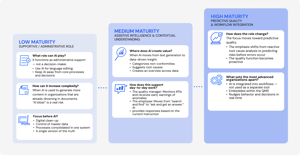
Low maturity: AI as administrative support
At low digital maturity, AI primarily plays a supportive and administrative role in quality work. Here, it makes sense to use AI for tasks such as language editing of procedures, translations, or drafting emails and standard communications. It can free up time and make everyday work easier, but it should not be confused with genuine quality improvements.
The risk arises when AI is used to produce more content in organizations that are already drowning in documents. AI bloat is a real challenge: more procedures, more versions, and even more material that no one actually uses in practice. In that situation, AI reinforces existing problems instead of solving them.
Before engaging more seriously with AI, the focus should therefore be on digital clean-up. This means getting control of master data, consolidating processes in one system, and ensuring a single version of the truth.
Medium maturity: AI as support for analysis and decisions
At medium digital maturity, AI begins to function as a practical tool for analysis and follow-up. Its use moves from simple text production to active support in quality work. At this stage, AI can understand context and provide analysis and an overview based on existing quality data.
In practice, AI can help categorize non-conformities more precisely and suggest root causes based on historical patterns. This strengthens the basis for decisions and reduces manual analyses that are often time-consuming and inconsistent.
At the same time, AI supports everyday work for both quality managers and employees. For the quality manager, it can monitor KPIs and identify anomalies before they develop into real problems. For the employee, it replaces the traditional search through documents with direct access to knowledge. Instead of searching through long PDFs, users can ask a specific question and receive an answer based on the current instruction.
At this level, AI functions as a competent co-pilot. It does not make decisions, but supports them and makes it easier to act in a timely and consistent way.
High maturity: from control to predictive quality
At high digital maturity, quality management moves from reactive control to predictive prevention. Here, AI is not used to explain what went wrong yesterday, but to indicate where risks may arise tomorrow.
In practice, AI can analyze relationships across large volumes of quality data and identify patterns that signal increased risk. This may include changes in suppliers, temperature fluctuations in production, or organizational factors such as new employees. In this way, the quality function can act before non-conformities develop into real issues.
The organizations that are furthest ahead integrate AI directly into the workflow. It is not a separate tool that must be actively remembered, but part of the QMS that operates in the background and supports decisions in real time. Quality thus becomes an ongoing management discipline rather than a subsequent control function.

AI only creates value when structure, data, and governance are connected. Are you ready for a foundation that can support both compliance and future opportunities?