

When digitalization creates more complexity than value
It often starts out well:
One system for document management. Another for non-conformities. A third for audit. Maybe an HR system on the side. A spreadsheet for everything that doesn't fit anywhere else.
Each solution may be strong on its own. But if they do not work together, friction starts to build in the form of:
-
Duplicate registrations
-
Manual transfers
-
Uncertainty about versions
-
Lack of a clear management overview
-
The data exists — but decisions are still based on gut feeling.
Best-of-breed solutions are not the problem. Lack of integration is. When data is brought together, it opens up new opportunities — for example, using AI in document management to identify patterns and areas for improvement.
Digital maturity is not about having fewer tools. It is about having a clear, consolidated management overview.

Before you decide, start a no-obligation conversation with one of our experienced advisors.


levels of digital maturity.
1. Digital – but fragmented
You have taken the right steps. You use digital tools, but they work in parallel
— not together:
-
Systems do not communicate
-
Getting an overview requires manual consolidation
-
Improvements depend on key individuals
Consequence:
You spend more time coordinating systems than improving processes.
2. Integrated — but not fully embedded
Here, the systems are starting to work together more effectively.
Data is up to date and available to the right people. Roles and responsibilities
are clearer. But:
-
Management does not use data consistently in decision-making
-
Insights come too late
-
Improvements happen reactively
This is where many organizations begin working more actively with AI
and digital maturity in quality management to strengthen decision-making.
Consequence:
You have structure — but you are not using its full potential.
3. Connected and ready to act
Here, the specialized tools function as part of one unified management system.
-
A clear overview is available in real time.
-
Audit reflects day-to-day practice — not a separate exercise.
-
Data is used actively in management decision-making.
-
Improvements are driven by insight, not firefighting.
This is where digital maturity becomes a competitive advantage.
Not because you have only one system, but because your systems work together
within one shared framework.
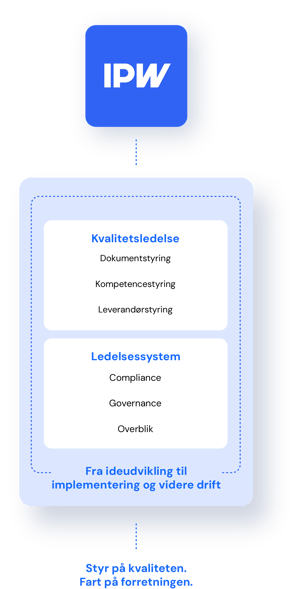
At IPW, we do not believe one system necessarily needs to do everything.
We believe the right tools should work together within a structure that gives management
a clear overview.
That is why we begin with:
-
Your existing processes and needs
-
Your workflows
-
Your integration needs
-
Your management ambitions
Sometimes that means bringing governance together on a single platform.
Other times, it means integrating best-in-breed solutions into a unified management system.


Digital maturity is not about starting over.
It is about taking the right next step.
If you are unsure where you stand or how your current systems can work better together, that is where we start.

We're more
than software.
With IPW, you don’t just get a system. You gain a partner with insight to understand your business. We’re with you all the way. From scoping and setup to ongoing guidance and development
- Configuration and implementation
- Workshops and user training
- Regular check-ins with your Customer Succes Manager
- Support from humans. Not bots
- Professional community and network groups
- Courses and learning with impact.