Typically, it looks something like this: QA drives the system, process owners contribute when needed, and the rest of the organization engages primarily around audit time.
There’s nothing wrong with starting in QA. The next step is to extend it across the organization. A quality management system creates the most value when it’s used where the work actually happens.
When the system loses its value
When the system isn’t anchored broadly, the effects start showing up in daily work. It rarely happens on purpose. Often, it starts with QA taking responsibility for getting the system up and running — and then continuing to drive it because the rest of the organization doesn’t see it as their job.
Over time, the consequences emerge. Engagement drops because the system doesn’t feel relevant to their daily work. Responsibilities blur because no one knows who drives what. And the system only comes into play when an audit is approaching.
The result can be a system that looks right on paper but doesn’t function as a real management tool. The basis for decisions weakens because the data no longer reflects the work actually being done. Learning across teams falls off, and the same problems keep resurfacing.
The biggest warning sign, though, isn’t errors — it’s silence. When there are few registrations, few improvement suggestions, and few questions, it can look like control. In practice, it’s often the opposite: a sign that the system isn’t embedded in the work.
The next step is to create clear ownership, active use in daily work, and a stronger foundation for follow-up.

Get a quick overview of where you stand and what the next step is.
Download our checklist with 4 concrete steps to build ownership in practice.

From QA system to culture: where are you today?
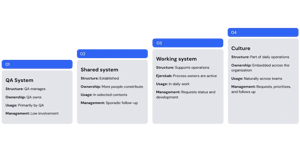
Most organizations move through the same levels — from a QA-owned setup to a genuine culture — and find themselves somewhere in between. There’s structure and documentation, but usage is still limited, and the system isn’t yet what drives the work.
The four levels below show the progression from a QA-owned setup to an organization where quality work is an integrated part of everyday operations. The difference isn’t in the documents — it’s in who uses the system and how. Where do you stand today?
What actually creates ownership?
Ownership isn’t an organizational exercise where you distribute responsibility on a chart. It doesn’t emerge by assigning it to a single place. It emerges from the interplay between several elements that together make the system usable in practice.
It requires a structure where QA sets the framework and ensures a shared methodology. Without a clear structure, practices quickly diverge across the organization.
It requires process owners who take responsibility for their own areas — not just by approving content, but by continuously developing and actively using it.
It requires the organization to work in the system as part of daily operations. This is where usage takes root — and where the value either becomes visible or disappears.
And finally, it requires leadership. When leadership prioritizes, follows up, and actively uses data, it becomes clear what matters. What leadership follows up on is what the organization works on in practice.
It’s the interplay between these roles that makes the difference — and it’s where ownership truly starts to work.
What the difference looks like in practice
This can sound abstract — but in practice, the difference is clear. Take deviation management as an example.
In many organizations, data is scattered across Excel files, emails, and different systems. QA spends time gathering and validating information, while follow-up happens case by case with no shared overview. The consequences reach further than that: it makes it harder for process owners to get a clear view of their areas, for employees to spot recurring issues, and for leadership to build a solid basis for decisions.
When the process is brought together in one place, the dynamic changes. Data is captured continuously in the same structure, so patterns and root causes become visible across the organization. That creates a shared foundation for prioritization and makes it possible to work more systematically with improvements.
The result is less coordination — and more focus on improvement.

The next step is to make the system part of everyday work.
Reach out for a no-obligation conversation about your setup and next steps.